
Why You Really Procrastinate

Ever wondered why you procrastinate? Is it really just a habit, or something deeper? A subtle pattern the mind creates, repeats, and eventually mistakes for identity.
Procrastination is the voluntary, unnecessary delay of important tasks despite knowing it will create negative consequences. But beneath the surface, it’s rarely about laziness. It’s about emotional regulation.
Everyone procrastinates. There’s nothing wrong with that, until it becomes a barrier between you and the life you want to build.
Procrastination isn’t laziness.
It’s a signal.
A story your mind tells to protect you from discomfort, uncertainty, or the fear of not being enough.
Once you understand the pattern, you can rewrite the coping mechanism behind it.
Everyone procrastinates to avoid negative emotions associated with the tasks. These emotions are typically anxiety, self-doubt, boredom or the fear of failure.
We procrastinate to avoid the emotions attached to a task: anxiety, self‑doubt, boredom, or the fear of failure. And avoidance shows up in familiar ways:
You pick up your phone “just for a minute,” and suddenly you’re 20 minutes deep into reels you won’t remember.
You walk to the kitchen again, not because you’re hungry, but because chewing feels easier than starting.
You sit staring at the task, replaying the same thoughts, convincing yourself you need “just a bit more clarity.”
Personally, I fall into the last one often — sitting, looping, thinking, but not moving.
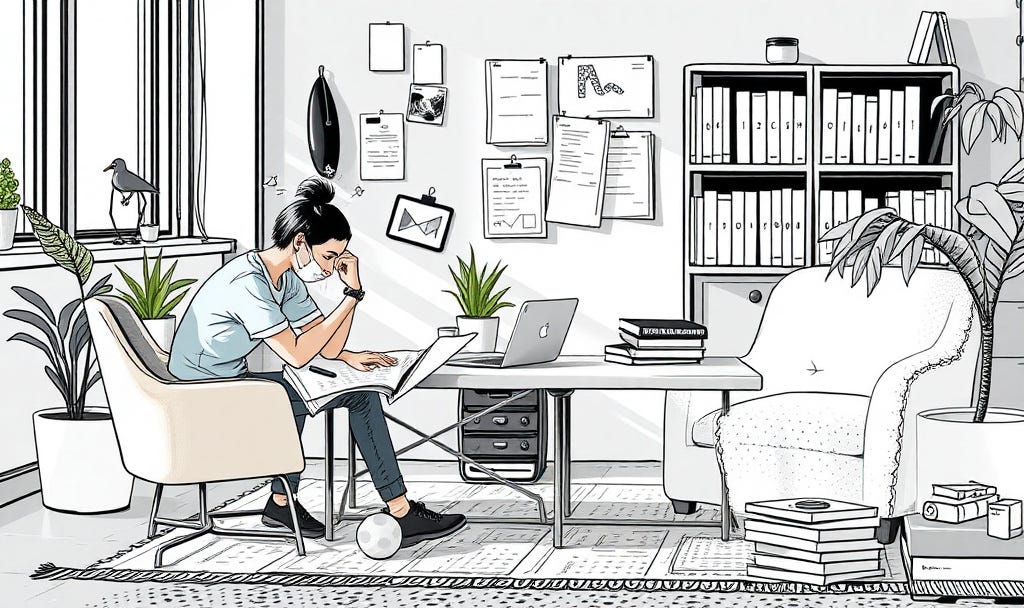
Procrastination is simply overthinking disguised as safety. The mind spirals so deeply into imagined outcomes that it becomes paralyzed. Thoughts repeat, but action freezes.
This heavy, looping state is what the Bhagavad Gita calls tamas. A fog of inertia where the mind knows what must be done but resists movement.
It’s like planting a seed and then never watering it yet expecting a tree to grow.
Thoughts alone don’t create results. Action is the water.
And here’s the deeper truth:
Procrastination is not the absence of action; it is the misdirection of energy.
The mind is active, just in the wrong direction.
“You may delay, but time will not” - Benjamin Franklin
So how do we break this pattern?
The mind procrastinates because it is fixated on the outcome.
It imagines success, failure, judgment, embarrassment and becomes overwhelmed by possibilities that don’t even exist yet.
The antidote is acceptance.
Accept that the outcome is never in your control.
Accept that uncertainty is part of every meaningful action.
Accept that without movement, none of the imagined outcomes good or bad can ever exist.
A farmer waters his plants daily knowing he cannot control the direction the plant grows or whether it bears fruit.
What he can control is the watering.
Ignorance is refusing to water the plant at all, guaranteeing that nothing grows.
To break procrastination, use this simple three‑step method:
Identify the trigger: What emotion are you avoiding — fear, boredom, uncertainty, self‑doubt? Write it down. Awareness dissolves half the resistance.
Release the outcome: Remind yourself: “The outcome is not in my control.” This shifts the mind from fear to acceptance.
Take one small step: The step can be tiny — opening the document, writing one sentence, organizing your tools, or even deciding, “I will take one small step now.”
A small step is too small for the mind to fear, and that’s why it works.
Once you begin, the mind shifts from “thinking mode” to “doing mode.”
Momentum builds.
Clarity returns.
Procrastination dissolves.
Small steps create momentum.
Momentum creates clarity.
Clarity creates action.
So, the next time you feel yourself delaying, ask:
What small action can I take right now toward this task?
Then take it.
The mind follows movement.